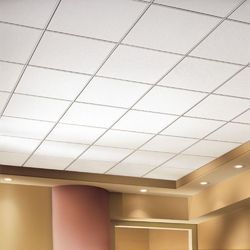
 Suspended ceiling systems are ceiling model that provides heat insulation and sound insulation at the same time in order to create an installation space for electrical productions and to obtain an aesthetic appearance. It is a preferred ceiling model to prevent unwanted images in the building. It provides the covering of bad images in the form of installation pipes, cables, walls and floors. Hospitals, buildings, hotels, offices, public service buildings, etc. Many buildings require suspended ceilings. It provides an aesthetic appearance and is easy to maintain. Preferably, a design that is compatible with the structure is obtained with illuminated colored ceiling systems or similar decorative ornaments. It may vary within itself according to the application areas. Let’s examine the types of suspended ceilings together.
Why is Suspended Ceiling Made?
Suspended ceilings are used in buildings such as sites, hospitals, various offices, business centers, inns, industrial industrial factories, conference centers, libraries, shopping malls, sports halls, both for heat and sound insulation and as visual decorative.
How to Make a Suspended Ceiling?
In the place where the suspended ceiling will be made, first the places are determined and the points are marked.
With the help of dowels, hanger bars are mounted on the ceiling and the elevation is fixed.
Hanger bars are connected to the C profile (main profile) with the help of hanger tongs.
Longitudinally extended C profiles are attached to secondary profiles with clips.
Plasterboard plates are mounted to the carcass system with stainless screws.
The screws must be well embedded in the plasterboard.
Joint tape is applied to the corners and joints.
Stainless screw heads are covered with plaster.
The surface is drawn with satin gypsum plaster. The cleaning is finished.
What are the Points to Consider in Suspended Ceiling?
Sufficient number of steel dowels should be used.
When mounting the U-profiles to the wall, the screws must be made with dowels.
Suspension bars must not exceed the required distance.
The board features should be chosen according to the function of the space to be used.
What are the Equipment Features Used in Suspended Ceilings?
Clip
It connects the secondary profiles to the main profiles, which have an important place as one of the suspended ceiling parts.
The main function of the clips is to do the fixing job.
Clip types are available for cable, pipe, panel clips, cover clips, anti-pass clips, screw clips.
Hanger Bars
Hanger rods are applied by passing through the dowels and they carry the hanger tongs.
There are different types in lengths such as 400, 600, 800, 1000, 1200, 1500 and 2000 mm.
Hanger Tongs
The hanger tong is applied by attaching to the hanger bar and carries the main profiles (TC).
Gypsum Ceiling Board (Gypsum Board)
The middle part of the board is plaster, the two surface sides are covered with cardboard of various colors according to the function of use, and smooth-surfaced sheets produced in certain sizes are called gypsum board.
Lightweight drywall, fire-resistant drywall, water-resistant drywall, moisture and fire-resistant drywall are available.
 Flooring Systems