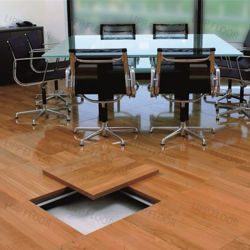
 The raised floor systems consists of several panels mounted on vertical adjustable pedestals. The pedestals are fixed on the concrete slab using suitable means, for example adhesives or mechanical fastenings.
Also, the spacing between the raised floor system and the concrete slab below can be varied and ranges from 7.62 cm (3 inches) to 121.92 cm (48 inches) as the pedestals are adjustable.
In addition, the panel of the raised floor system consists of cement or wood core with steel or aluminum cladding and its dimensions are 60.96cm by 60.96cm. Finally, the panels are compatible with various floor coverings such as vinyl, linoleum, laminate, rubber, carpet and stone or ceramic tiles.
Typically Best Suitable for Raised Floor Systems
Computer rooms and other information technology areas.
General open office spaces.
Training and conference areas.
Exhibition areas.
electrical cabinets, fan rooms, etc. Support areas for offices incl.
clean rooms
Areas Not Suitable for Raised Floor Systems
Laying in Leveling Positions
The raised floor system is not suitable to be placed directly on the floor. Because protection against heat, pollutants and moisture carried by soil, soil gas and groundwater cannot be provided for a long time.
Toilet, Shower, Bathroom, Dish Washing and Other Wet Areas
Plumbing fixtures are often installed in these areas, which can leak and cause panels to fail.
Kitchen and Meal Preparation Areas
High humidity and possible spilled food, liquids and leaks make these areas unsuitable for such floor systems.
Laboratories
In addition to moisture, the possibility of chemical and biological spills and the presence of plumbing make the laboratory unsuitable for a raised floor system.
fire escapes
Stair landings need to interface with any adjacent raised floor as a well-supported flat condition with the edge of the access floor.
Mechanical Equipment Rooms
Examples of such rooms include air handling equipment, chiller and boiler. It can be understood from their names that these rooms have conditions that the raised floor system panels will deteriorate and damage.
Advantages of Raised Floor System
This type of floor system solves the problem of shear transmission across the diaphragm.
Raised floor system is waterproof
Causes reduced construction cost in high seismic areas
The raised floor system can act as a high thermal mass base material for radiant heat systems dissipated by hot air or hot water. Therefore, it is more efficient to heat and cool a building with a raised floor system.
The concrete surface can be finished as a topcoat by sealing, polishing, stamping or painting as desired. As a result, the extra cost of coating used to cover floors will no longer be needed.
Acoustic isolation is another advantage offered by the raised floor system.
In areas with high wind threat, the raised floor system will increase the lateral resistance and durability of the multi-storey building, especially when combined with the concrete roof system.
 Flooring Systems